


Is This a Tooth Cavity or Internal Resorption?
I’ve seen two dentists in the last three weeks, and both say my tooth has a large cavity inside it. They told me the damage was extensive and said they were surprised I wasn’t experiencing severe pain. After the first dentist showed me the X-ray, I got a second opinion because I had no symptoms, but the diagnosis was the same.
Today I felt throbbing in the gum below that tooth, and I’m concerned it may be getting worse. Both dentists said the tooth could eventually fracture, causing significant pain, so maybe it fractured.
Would it be better to try to save the tooth with a root canal, or should I have it removed and replaced with an implant? The tooth above it already needs an implant because a previous root canal and crown didn’t help, and the post repeatedly fell out. – Thanks. Whitley from Tacoma, WA
Whitley,
A hole that develops inside a tooth is often the result of a condition called internal resorption.
Since two dentists have provided the same diagnosis, you can be reasonably confident about the cause of your symptoms. Internal resorption is a rare condition in which inflammation inside the tooth causes the tooth structure to break down from within. Because the process starts inside the pulp chamber, it can sometimes look very different from a typical cavity.
Can a Dentist Save a Tooth Affected by Internal Resorption?
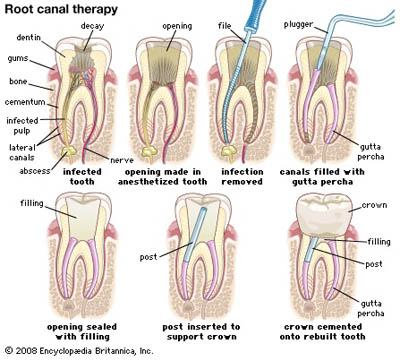
Many teeth affected by internal resorption can be saved. When a dentist diagnoses it before extensive damage occurs, root canal treatment is often the most conservative approach. Removing the inflamed tissue stops the resorption process and allows the tooth to be restored. Saving natural teeth whenever possible often provides the best long-term function and comfort.
What Factors Affect Treatment Decisions?
The right treatment depends largely on how far the resorption has progressed.
Every case is different, but these are some of the factors to consider:
- The extent of the internal damage
- Whether the root has been perforated
- The amount of remaining healthy tooth structure
- The likelihood of long-term success after treatment
If you’ve had a failed root canal in the past, it is understandable to feel hesitant about repeating that treatment.
When Is it Best to Replace the Tooth?
A dental implant may be the better choice if the resorption has severely weakened the tooth. Also, if the damage extends through the root, treatment becomes more challenging. Even if the perforation can be repaired, the remaining tooth structure may not be strong enough to withstand normal chewing forces over time. In those situations, extraction and replacement with an implant can provide a more predictable long-term outcome.
Dr. Thaddeus Michalski, a Rocky Hill, Connecticut dentist, sponsors this post. Read why many of his patients say he is the best dentist in town.
Can a Cavity Start from Inside a Tooth?
I relocated three years ago and have switched dentists a few times, trying to find one that I like as much as my dentist in Ohio. After my six-month exam, my new dentist said I have a cavity forming inside an upper molar. I’m surprised. I don’t have a history of cavities, and I see no outward signs of one. Could I have a cavity that started inside my tooth? Thanks. Terry from PA
Terry,
A cavity cannot form inside a tooth without an external point of entry. Tooth decay always begins on the surface and progresses inward. When bacteria reach the inner portion of the tooth, an infection develops, often requiring root canal treatment.
If your dentist described a problem that looks like decay starting from within the tooth, they may be referring to a different condition.
A Rare Condition That Might Resemble Decay
 One possibility is internal resorption, a rare condition in which the pulp begins to break down the tooth structure from the inside. The exact cause isn’t fully understood, but it appears to involve inflammation of the pulp. Some irritation usually triggers that reaction.
Without a history of decay, trauma can contribute to resorption, especially if a tooth protrudes and absorbs excessive force.
Because this condition is rare and easily mistaken for other issues, we recommend seeking a second opinion from an endodontist. That approach helps ensure the diagnosis is accurate before you commit to treatment.
When you seek that opinion, keep the process as neutral with these steps:
- Ask for a copy of your X-ray to bring with you.
- Don’t share the name of your current dentist or their diagnosis.
- Let the specialist evaluate the images independently.
Hartford, Connecticut, dentist, Dr. Thaddeus Michalski, sponsors this post. Read why many of his patients say he is one of the best dentists in town.