


Is a Six-Tooth Bridge Safe for Replacing My Missing Front Teeth?
Is a six-tooth dental bridge safe for replacing my missing front teeth? My dentist recommended a six-tooth bridge that connects two of my teeth with two dental implants. The bridge will replace my right front tooth and the one behind it. This doesn’t sound like a good idea, but I have no basis for saying it. I feel comfortable. What questions should I ask before agreeing to the bridge? – Thanks. Josef from NV
Josef,
When replacing missing teeth, your dentist may suggest connecting dental implants to natural teeth in a single bridge. This approach can sound efficient, but it’s not always the simplest or healthiest option. Understanding the differences between teeth and implants can help you make an informed decision about your care.
Why Use Caution When Connecting Natural Teeth and Implants?

Natural teeth connect to bone through ligaments that allow tiny amounts of movement. In contrast, dental implants fuse with the bone, making them rigid. This difference can strain the connection and may damage the supporting teeth.
While research shows that joining teeth and implants can work, it requires meticulous planning and expert technique to avoid long-term complications.
What Are the Risks of a Single Connected Bridge?
Joining your front teeth and implants into one bridge introduces several potential problems:
- If one tooth or implant fails, the entire bridge must be replaced. Keeping teeth and implants separate makes repairs easier and less expensive.
- Cleaning becomes more difficult. A connected bridge requires a floss threader or specialized cleaning tools that take more time and effort.
Many dentists recommend separating the bridge sections or using individual crowns when possible to minimize complications.
Alternative for Replacing a Missing Front Tooth
In many cases, the most practical solution is to replace the missing tooth with a single dental implant. It is strong, stable, and easy to clean. A less expensive option is a removable flipper partial denture. It’s not as durable as an implant, but it can be a budget-friendly option.
Ask your dentist to explain why he recommends a bridge that connects your natural teeth with dental implants and whether a single implant or a smaller bridge design might be healthier. You can also get a second opinion from an experienced cosmetic and implant dentist.
Dr. Thaddeus Michalski, a Rocky Hill, Connecticut dentist, sponsors this post.
My Permanent Canine Tooth Won’t Erupt
I’m 16 and one of my baby canines hasn’t fallen out yet. When I was 14, I lost the other one, and the adult tooth did come in, though it took about six months. At my checkup last year, the dentist said I had all my adult teeth, but my small mouth makes them erupt slowly. He expected I’d lose my other baby canine soon.
It’s been a year, and the tooth isn’t even wobbly. I’m starting to worry I might have a gap when the tooth finally comes out. My dentist didn’t make it sound like a problem, and I can’t find much about it online. Are there any temporary options to cover the space until the adult tooth grows in? – Thanks. Jakob
Jakob,
By age 14, permanent canines should already have erupted. If they haven’t, there is usually an underlying issue. Canines often become impacted and cannot erupt without help. Addressing the problem early makes treatment easier both clinically and socially. Waiting until 16 or 17 complicates the process.
Using an X-ray to Identify Tooth Location and Treatment for Eruption
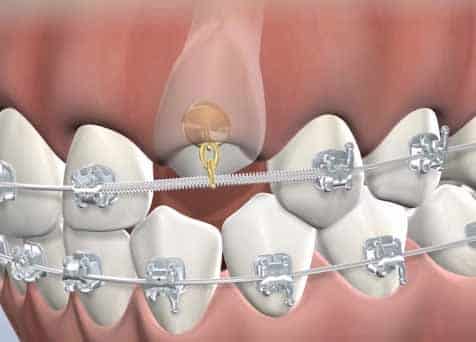 A panoramic X-ray can reveal the position and development of the permanent canine. If the root is not fully formed, the tooth still has eruptive force. Removing the baby tooth can create space for eruption. If the baby canine feels loose, the permanent crown is probably nearby. If not, the X-ray will clarify its position and readiness.
Because treatment depends on accurate interpretation, it’s wise to consult an orthodontist. They can evaluate whether the tooth will erupt naturally or require surgical help. Avoid using a replacement tooth to cover the space, since this may block eruption.
What Happens If the Tooth Is Impacted?
An orthodontist can expose the crown of the impacted permanent canine to guide it into place and allow it to erupt. Placing an orthodontic bracket on a tooth and guiding tooth movement with a spring and chain on the bracket can gradually help move the tooth into position.
Dr. Thaddeus Michalski, a Rocky Hill, Connecticut dentist and Diplomate of the International Congress of Oral Implantologists, sponsors this post. Read how he strives to provide some of the best dental care in Rocky Hill.